Skip to content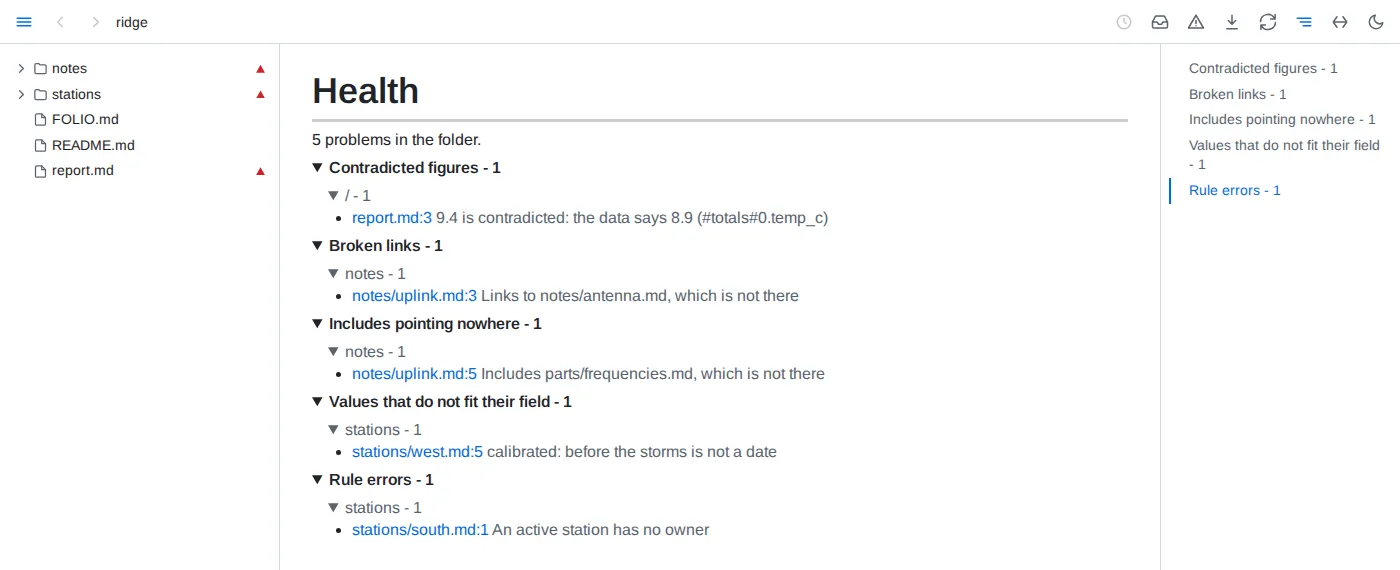
- Declarations - a folder declares its conventions in a file named
FOLIO.md, in capitals: a page like any other, whose ```yaml folio fences each hold a YAML map of sections - kinds, rules, health, attention, stale, save, related and digests - between prose saying why. Editors and GitHub highlight such a fence as YAML. Every yaml folio fence of the file is read, in order, and a file may hold any number; a plain ```yaml fence, or any other, is an example, and a file named folio.md is an ordinary page.
- Layering - a declaration applies to its folder and everything below it. A deeper one adds to those above: a kind or rule it names again replaces the one above in its place, and its health entries follow theirs. Paths a declaration names are relative to its own folder.
- Kinds -
kinds maps a kind's name to where - a path pattern relative to the declaration's folder, or a list of them, where ** crosses folders and * and ? stay in one, so *.md names only the folder's own files - and fields. A document is of the first kind placing it, kinds of the nearest declaration first; a kind declared again nearer replaces the one above.
- Fields - each field names where its value is read with
from: frontmatter (a key of the YAML frontmatter), label (a line **Label:** value, **Label**: value or Label: value starting any line of a paragraph or a list item, numbered or not, so labels may stack line under line; its label matched ignoring case), section (the text under a heading, up to the next heading of its level or above), folder (the name of the folder holding the document) or name (the file's name without its extension, or the first group of pattern matched against it). key names the key, label or heading when it differs from the field's name. type is text - from a label or section, the plain text a reader sees, without markup or HTML tags -, number, date (an ISO date or time), link - a markdown link, or with to: <kind> an id naming the document of that kind whose id field, or the field by names, holds it - or list, its items each of type of, written as list items or set apart by commas. A list of links takes every link in each item, and with to, every id of that kind written anywhere in the line, so notes beside them, line break tags and closing punctuation stay notes; a link with to into the folder must lead to a document of the kind, or name one by the id its text holds, and a link to the web is taken as written. An item naming nothing is listed in health - prose, and a lone word without a digit where every id of the kind holds one, only when nothing else in its line is a link or an id; in a list written one item a line, each item is a line of its own, an indented line carries its item on and any other line is a note - a document's own id never names it, and a line opening with an empty text names nothing. empty names texts written for no value, such as None. A field is read from the document's own text: a label or section an include brings in belongs to the file holding it. A value that does not fit its type is listed in health under Values that do not fit their field, at its line. A where naming a folder as it is, with no wildcard, places nothing and is listed with the declaration's problems, as is a health entry's. Documents are only read: nothing is written into them.
- Rules -
rules maps a rule's name to its query, which should return no row, its message - {column} in it takes each row's value of that column; the rule's name by default - and its severity, error (the default) or warning. The query runs from the declaration's folder and reads data files and the folder's documents as any query does; every row it returns whose path lies below the declaration's folder is a violation, listed in health under Rule errors or Rule warnings at that path, and at its line or block when it returns them; rows reading alike are listed apart. Health lists a rule's first 10,000 rows, and past them says at the rule's own line how many it returned. A rule declared again in a deeper declaration judges the documents below that folder in its place. A rule whose query fails, or that returns no path column, is listed at its own line with the rule's severity. Violations come and go with every change to what the rule reads.
- Health -
health is a list of entries, each with where - path patterns relative to the declaration's folder - and skip, error or both: all, or kinds of check among figure, link, include, loop, diagram, chart, query, data, declaration, field, rule and view. A problem whose document a skipping entry places is left out of the health view; one of a kind an error entry names there counts as an error, which fails folio check - with no such entry, only the violations of a rule whose severity is error are errors. Deeper declarations add entries for their own folders. skip: all also keeps off what needs you every attention row naming a document the entry places, and the error of an attention query declared in a FOLIO.md it places. Nothing else changes: the documents are served, indexed, queried and caught up on as before.
- Attention -
attention maps a name to a query and a message, as a rule does: every row the query returns needs the reader, listed under Needing attention in what needs you at the row's path, its message filled from the row's columns. A query that cannot run, or returns no path, is listed among the errors.
- Stale -
stale is a map holding a query: below the declaration's folder, the documents it names by path are the ones that have outlived their use, in place of the default - a document whose text has not changed for a year - by its last commit or the save Folio first saw it in, its file's time only when there is neither, since a checkout resets file times - never read and linked to from no other document. The nearest declaration holding one decides for each document, and a document it names leaves the list once read or edited in the past year, or linked to; a query that cannot run, or returns no path, is listed itself.
- Digests -
digests names digest documents Folio writes and keeps current; see Digests.
- Save -
save is a list of entries, each with where - path patterns relative to the declaration's folder - naming the documents Folio may write views into. Nothing else is written but the digest documents digests declares.
- Related -
related is a list of entries, each with where - path patterns relative to the declaration's folder - naming the documents whose blocks Folio relates by meaning; see Related by meaning.
- Live - an edit to a declaration applies at once.
- Broken - a fence that is not YAML, is not a map, names a section Declarations does not list or gives one the wrong shape is listed in health under Declarations that cannot be read, at its line, and left out; the file's other fences still apply.
- Inspect - a block's ⓘ names the declarations applying to its file, in the order they layer, and its kind and each field's value;
?conventions gives the same.